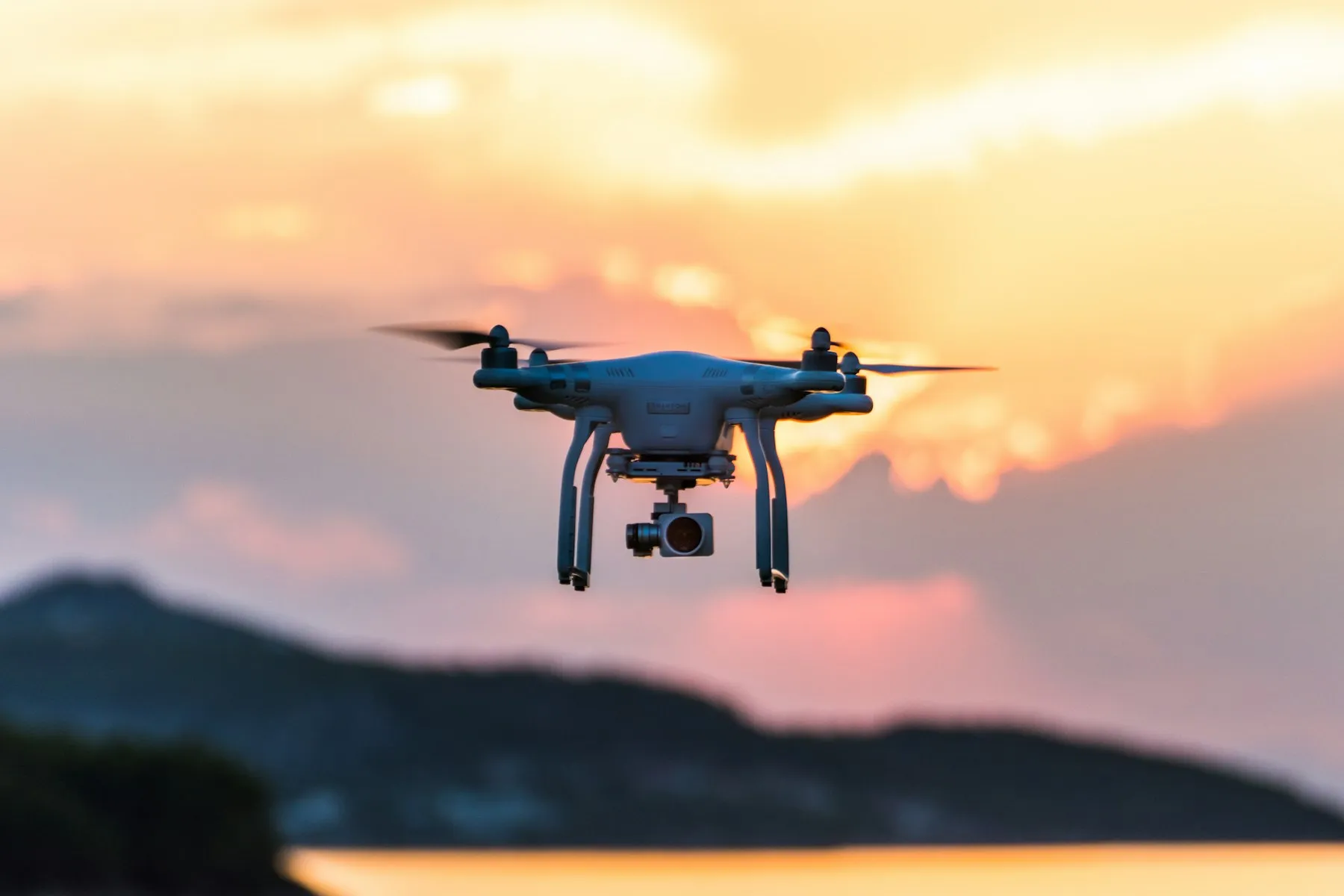
For most of the last decade, drone development was measured in flight time, payload, and camera specification. Acoustics were an afterthought — something addressed in a footnote about propeller design.
Then several categories of use turned out to be gated on noise rather than on capability, and the footnote became a programme.
Why the sound is so unpleasant
A multirotor produces a tonal signature: strong peaks at the blade passing frequency and its harmonics. Human hearing is unusually sensitive to exactly that pattern, and unusually good at detecting it against background noise.
This is why a drone at a hundred metres can be more annoying than a road at fifty. Total acoustic energy is not the issue. Tonality is. A broadband hiss at the same level disappears into the environment; a tone does not.
The consequence is that reducing decibels alone does not solve the complaint. Spreading energy across frequencies does.
What worked
Three changes account for most of the improvement in current airframes.
More, slower blades. Adding blade count while reducing rotational speed moves the fundamental frequency down and reduces peak amplitude. It costs some efficiency, which was the reason it was avoided for years.
Uneven rotor speeds. Running rotors at deliberately slightly different speeds smears the tonal peak across a band. The aircraft does slightly more work to hold attitude and sounds substantially less like a machine.
Serrated and swept blade edges. Borrowed directly from wind turbine research, where the same complaint drove the same work a decade earlier.
What it unlocked
Quieter aircraft made three things possible that endurance never would have.
Delivery in residential areas, where the binding constraint was always neighbours rather than regulators. Wildlife survey work, where the observation was previously invalidated by the observer. And inspection in occupied buildings, which was simply not tolerated when the machine sounded like a hive.
None of these required longer flights. They required not being noticed.
The uncomfortable implication
The same property that makes drones acceptable near homes also makes them harder to detect, and detection has been a meaningful part of how people notice they are being observed.
That trade-off is being handled unevenly. Some jurisdictions require remote identification broadcast, which restores a form of awareness through a different channel. Others have not addressed it at all.
It is worth being clear that the engineering here was a straightforward response to a legitimate complaint. The governance question it opened is separate, and it has been moving considerably slower than the propellers.